The best audio mixers depend on what you connect: an XLR mic and instruments call for different inputs than a game-and-chat streaming setup. These picks cover channel control, gaming audio features, and recording interfaces so you can match the mixer to your workflow.
Quick Top Products
FIFINE AmpliGame SC8P
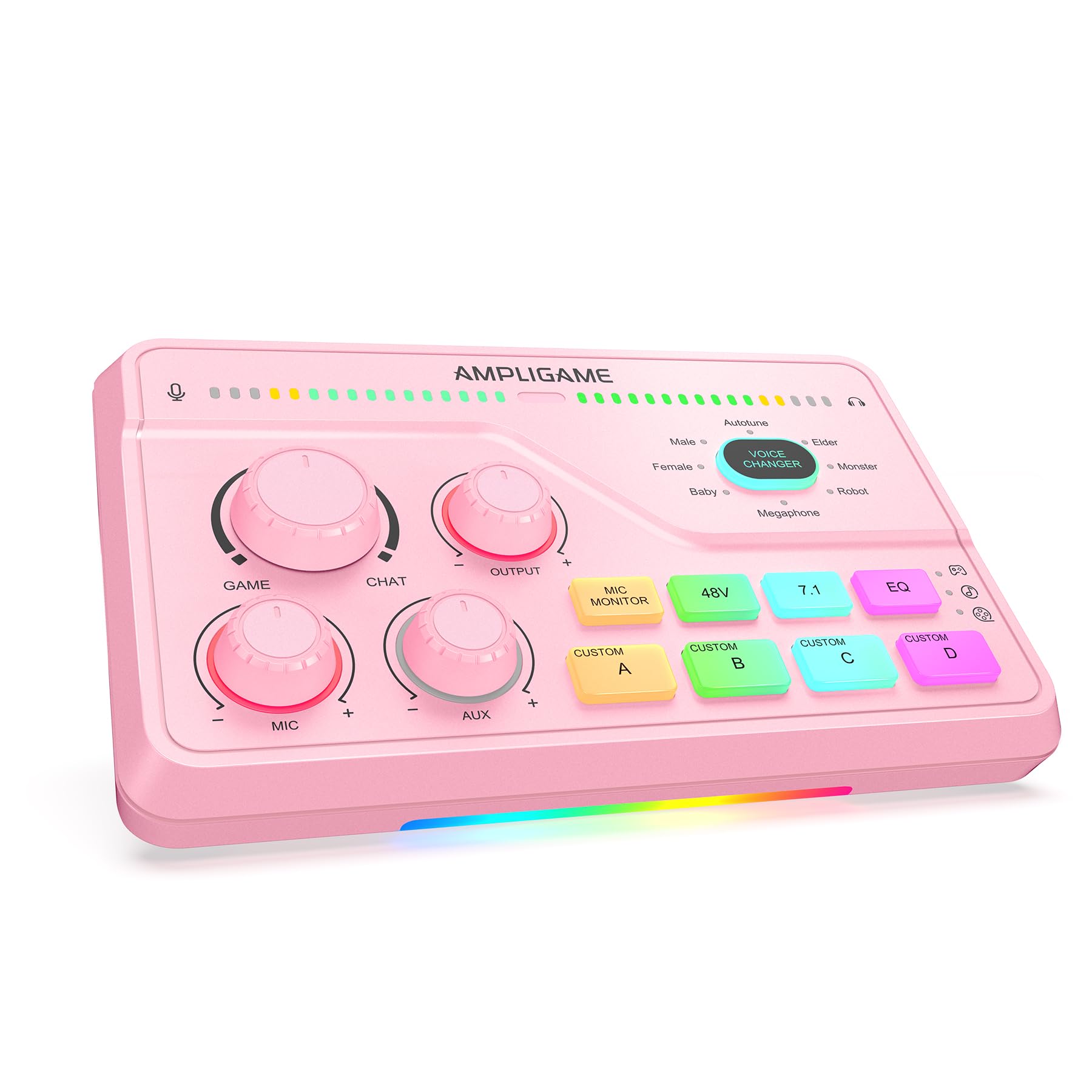
- Three knobs independently control mic, game audio, and background music.
- XLR input includes 48V phantom power and a dynamic/condenser switch.
- Optical AUX, 3.5 mm AUX-In, and USB-C support several gaming devices.
Best For: Gamers and streamers who want separate controls for microphone, game audio, and background music.

FIFINE AmpliGame SC8W
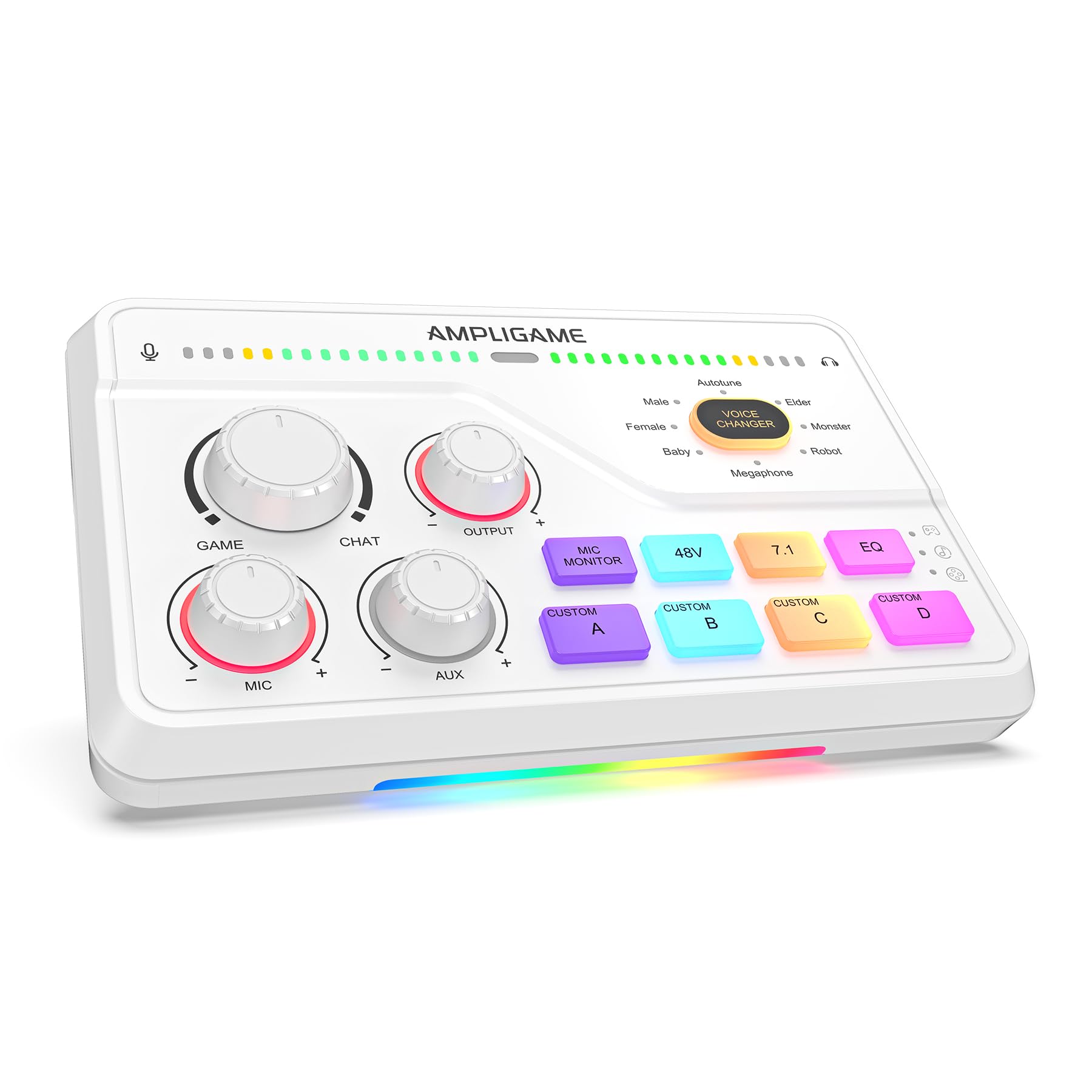
- A dedicated dial balances game audio and chat.
- Eight voice effects and four custom sound keys support live sound changes.
- USB-C, optical AUX, and 3.5 mm AUX-In cover different device connections.
Best For: Streamers who want dedicated game/chat balancing plus voice effects and programmable sound keys.
FIFINE AmpliGame SC8
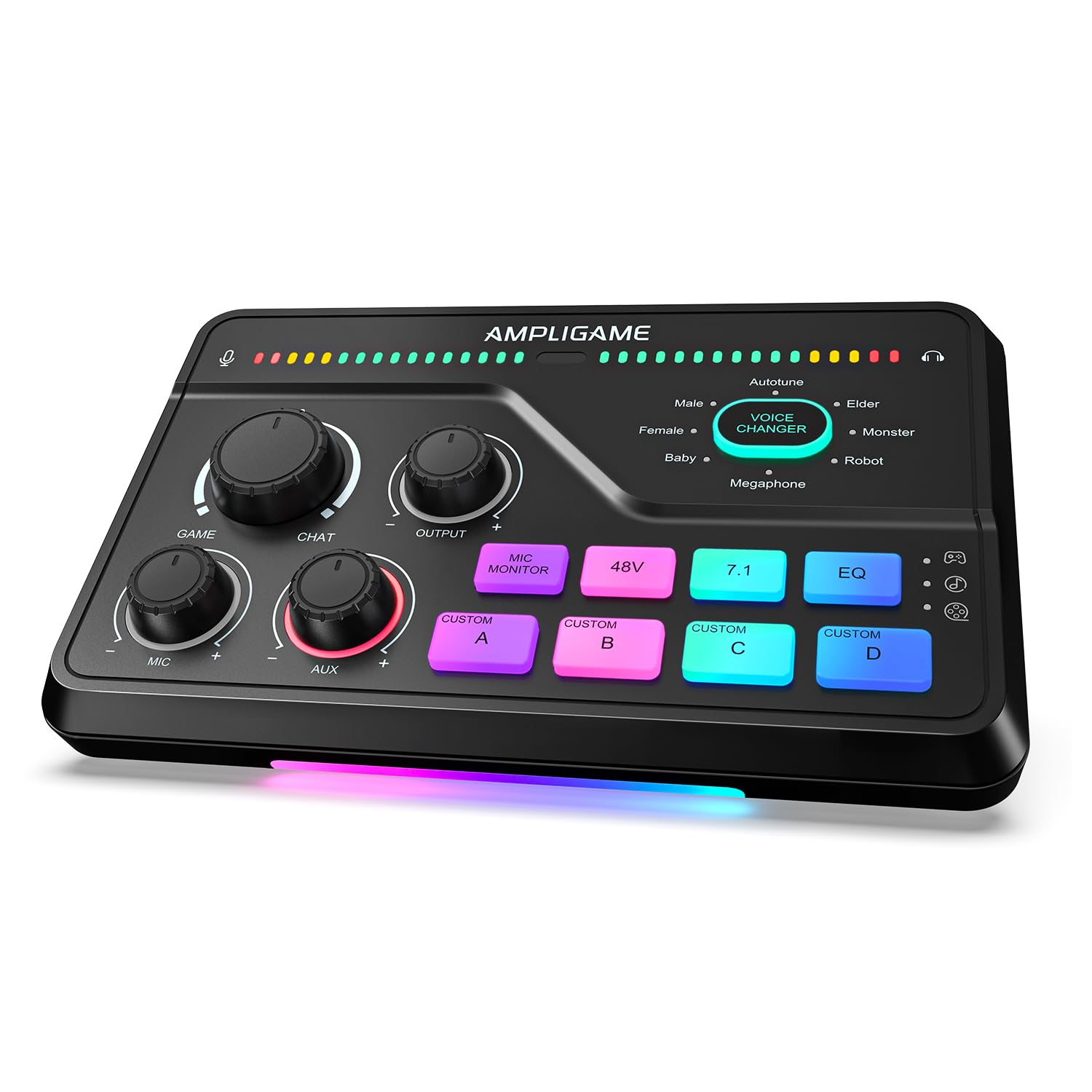
- Game/Chat balance and three EQ presets tailor gaming audio.
- Four customizable buttons can store audio pieces.
- The mixer supports XLR or 6.35 mm mics, not USB microphones.
Best For: PC and console streamers who want 7.1 audio, voice changing, and customizable sound controls.
FIFINE AmpliGame SC3W
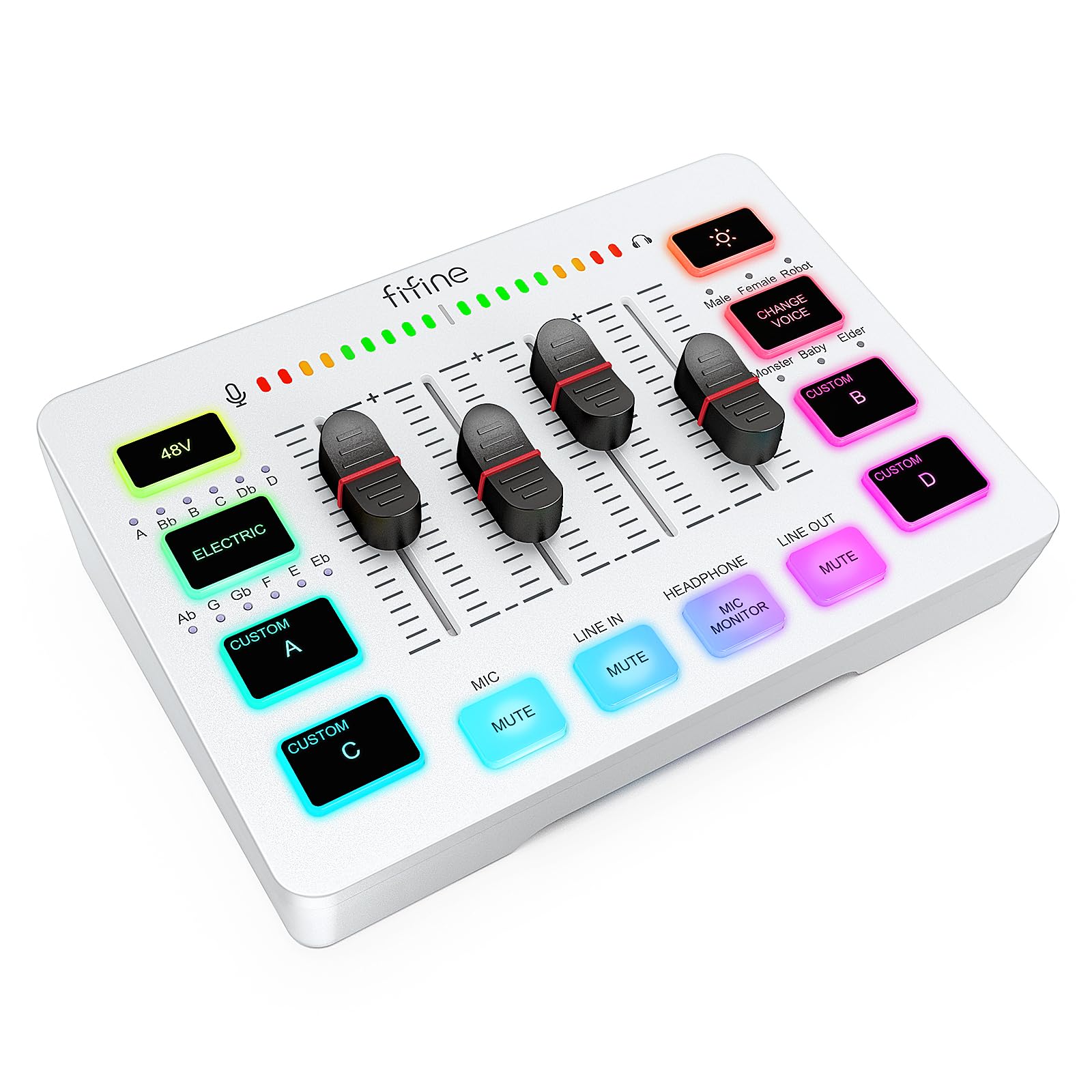
- Four individual control channels can be adjusted separately.
- XLR input includes built-in 48V phantom power.
- It supports dual-PC streaming and includes real-time monitoring.
Best For: Streamers who want four individually adjusted channels, an XLR mic input, and RGB effects.
FIFINE AmpliGame SC3
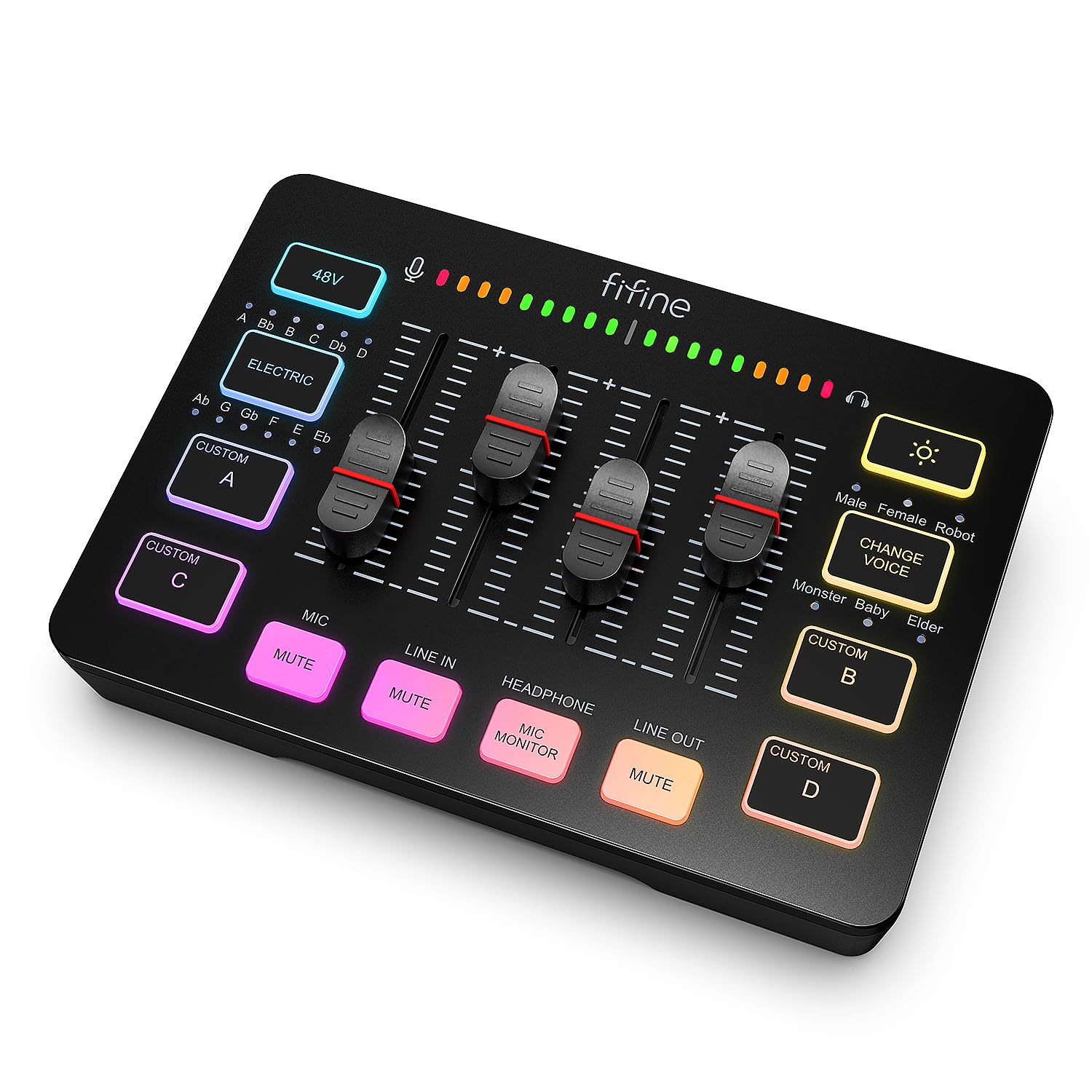
- Four independent channels control mic, line-in, headphones, and line-out.
- Includes a volume fader, front mute, and monitoring buttons.
- Four sound buttons and six voice-changing modes add effects.
Best For: Beginning streamers who want independent microphone, line, headphone, and line-out volume controls.
MAONO MaonoCaster G1 NEO
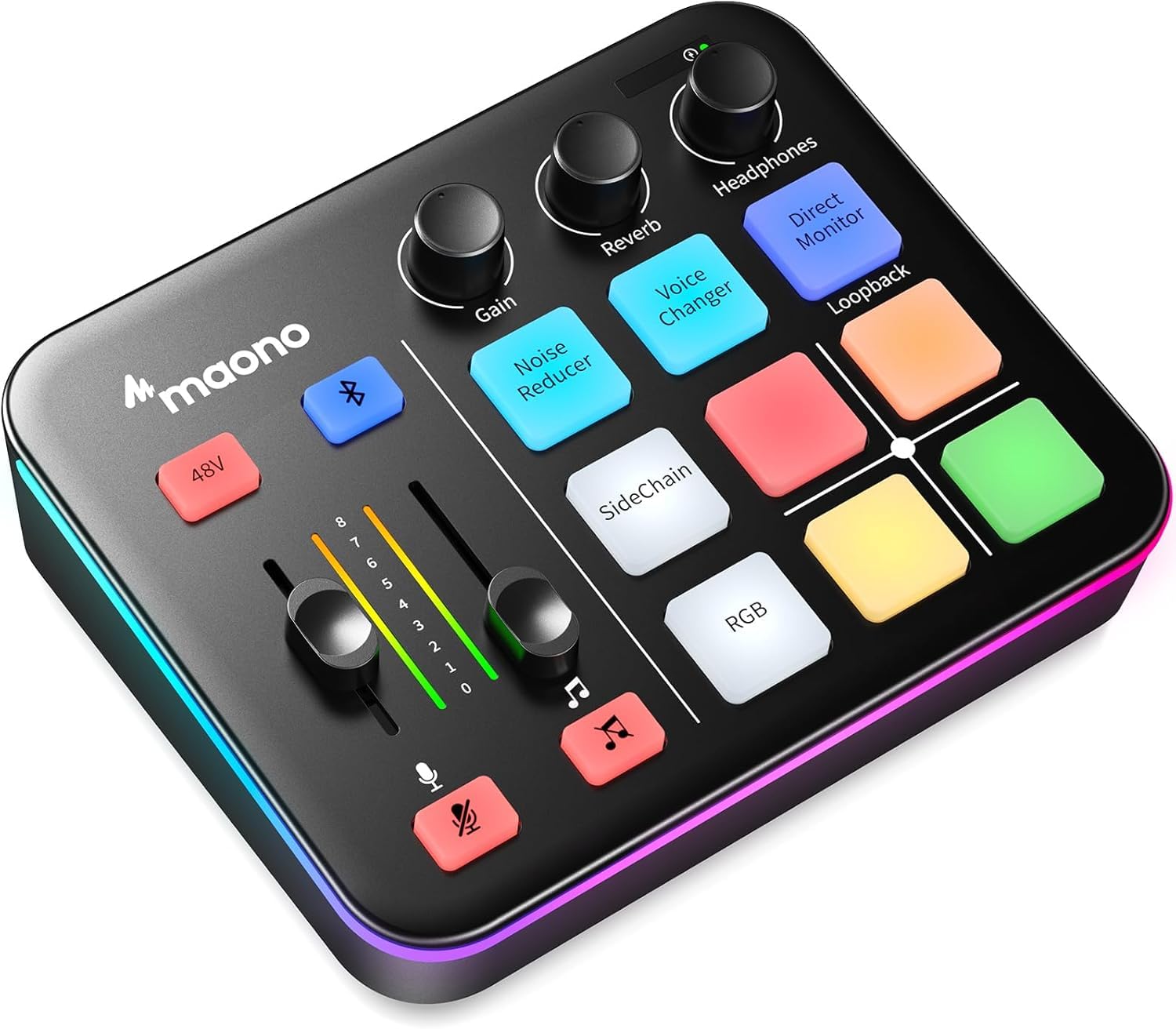
- Bluetooth accompaniment input adds audio to streams.
- XLR input has a Pro-preamp and 48V phantom power.
- Loopback, direct monitoring, and one-click mute support live operation.
Best For: Gamers and new streamers who want Bluetooth accompaniment, sound pads, and an XLR microphone input.
FIFINE Ampli 1
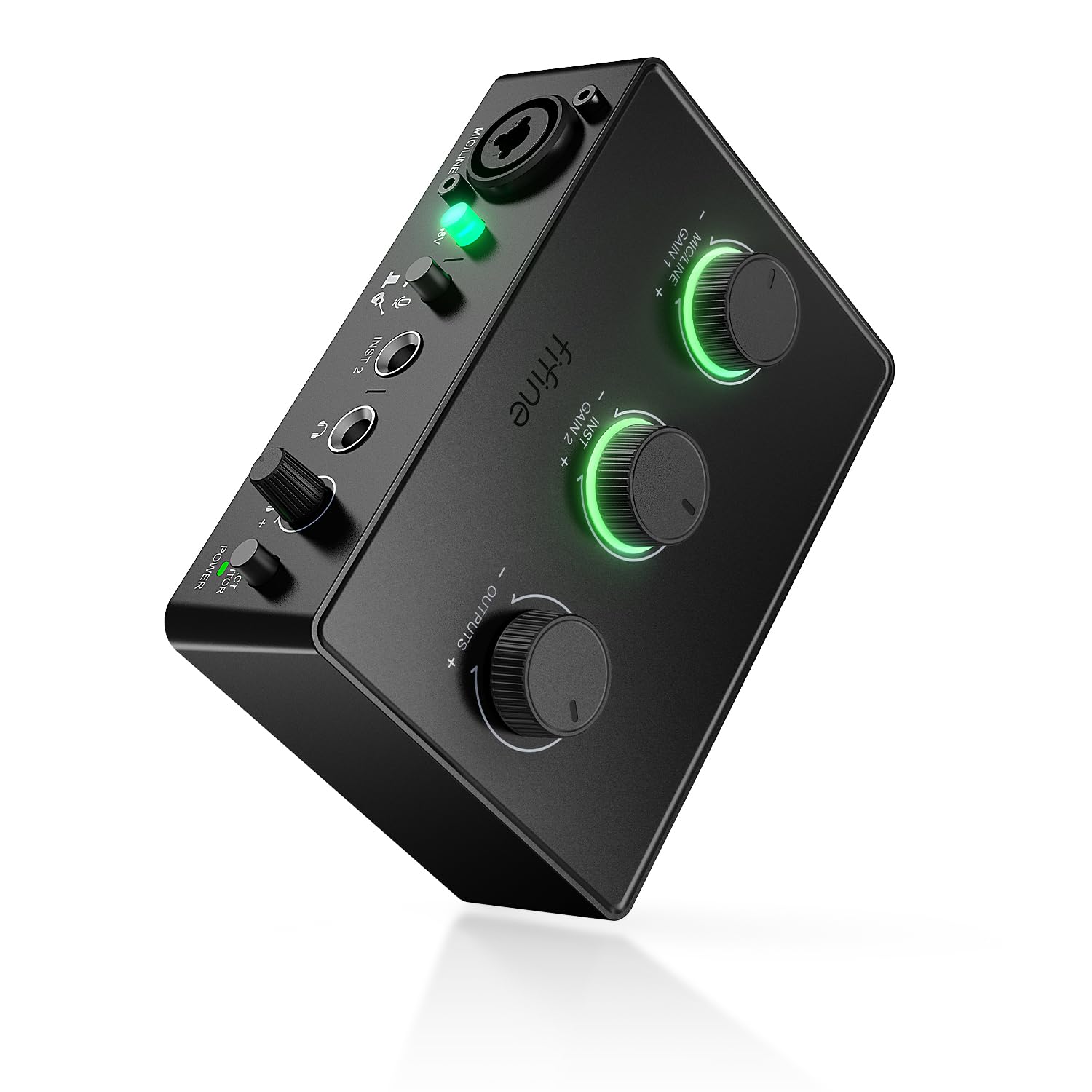
- Provides one XLR microphone input and one instrument input.
- 48V phantom power and a mic gain knob support input adjustment.
- Dedicated direct-monitor and output-volume controls are included.
Best For: Home recordists who need an XLR microphone input and a dedicated guitar or bass input.
Best for Game and Chat Control
FIFINE Streaming Audio Mixer with XLR Mic Interface & 7.1 Surround Sound, Gaming RGB Mixer for PC/PS4 with Individual Volume Knob, 3 EQ Mode, 48V Phantom Power,Voice Changer-AmpliGame SC8P
The AmpliGame SC8P is built around gaming and live chat, with three volume knobs that separately adjust microphone, game audio, and background music. Each knob has a mute button, and the mixer adds optical AUX for PS4 or TV, 3.5 mm AUX-In, and USB-C plug-and-play connections for PC, PS5, Switch, or mobile devices.
XLR input with 48V phantom power and a dynamic/condenser switch supports different mic types. Virtual 7.1 surround and three EQ modes add headphone-focused game audio features.
Its focus is game and stream control, so check the connection path and mic type against your setup.
Best For: Gamers and streamers who want separate controls for microphone, game audio, and background music.
| Pros | Cons |
|---|---|
|
|
Choose this mixer if game sound, chat, and background audio need their own physical controls. Optical AUX is useful for a PS4 or TV connection, while USB-C covers several other devices.
The virtual surround and EQ modes are headphone-oriented extras, not a replacement for choosing the right inputs for a music recording setup. Check that your mic uses XLR and confirm the cable and connection requirements for your particular console or computer.
Best for On-the-Fly Voice Effects
FIFINE Audio Mixer for Gaming with 7.1ch Surround Sound-Volume Knob-Mute-Voice Chat, RGB Computer Mixer with XLR Mic Interface Compatible wtih TV for Live Streaming-AmpliGame SC8W
The SC8W combines game-focused audio routing with quick-access controls for live streams. Its Game/Chat dial balances those sources, while three knobs and mute controls allow adjustments without leaving a game.
It connects to PS4 or TV over optical AUX, accepts additional sound through 3.5 mm AUX-In, and uses USB-C for PC, PS5, Switch, or mobile devices. The XLR input has 48V phantom power and a dynamic/condenser switch.
Eight voice effects, four custom sound keys, virtual 7.1 surround, and RGB lighting round out a feature set aimed at interactive gaming and streaming rather than general studio mixing.
Best For: Streamers who want dedicated game/chat balancing plus voice effects and programmable sound keys.
| Pros | Cons |
|---|---|
|
|
The SC8W fits a streamer who wants a dedicated game/chat balance control and quick sound effects. Its optical and analog inputs can help combine audio sources, while USB-C handles supported devices.
That specialization means it is less clearly suited to recording instruments or managing a conventional multi-mic session. Before buying, check that your computer or console connection matches the available ports and that your microphone is XLR if you plan to use the mic input.
Best for Customizable Streaming Controls
Fifine Gaming Mixer for Voice Chat and Streaming- 7.1ch Surround Sound Headphone Amp-XLR Preamp-USB Plug & Play-Voice Changer-RGB-Volume Control-3 EQ Modes Ampligame SC8
This AmpliGame SC8 is a gaming mixer with a Game/Chat balance dial, three EQ presets, virtual 7.1 surround, and eight voice-changing effects. Three smart knobs include push-mute controls for mic, game, or background audio, and four buttons can store sound clips.
Its XLR input supports 48V phantom power and a dynamic/condenser toggle; the notes also mention 6.35 mm microphones. USB-C plug-and-play, optical AUX, and 3.5 mm AUX-In cover PC, console, and auxiliary audio paths.
This broad feature set favors gaming and stream interaction. It does not support USB microphones, and an XLR cable is not included.
Best For: PC and console streamers who want 7.1 audio, voice changing, and customizable sound controls.
| Pros | Cons |
|---|---|
|
|
Pick this model if you want gaming audio controls alongside programmable sound buttons and voice effects. The XLR and 6.35 mm mic support offers options for compatible microphones, but USB mic owners will need a different setup.
Its Game/Chat dial and EQ presets are intended for gaming audio rather than instrument-focused recording. Confirm your mic connector and plan for an XLR cable if needed; then check which of USB-C, optical AUX, or 3.5 mm AUX-In suits your devices.
Best for Four-Channel Streaming Control
FIFINE Audio Mixer, Gaming Streaming PC Mixer with Slider Fader, XLR Microphone Interface, Monitoring, for Video/Game Voice/Podcast Recording-AmpliGame SC3W
The AmpliGame SC3W provides four individual control channels for adjusting connected devices, with a volume fader for hands-on level changes. It has an XLR microphone input with built-in 48V phantom power, plus mute, volume adjustment, and real-time monitoring.
Its multiple rear audio ports support dual-PC streaming or connections to other audio devices. Voice changing, a customizable sound button, and RGB lighting add a presentation angle for game voice and live entertainment streams.
Check port compatibility before buying if you need a particular routing arrangement.
Best For: Streamers who want four individually adjusted channels, an XLR mic input, and RGB effects.
| Pros | Cons |
|---|---|
|
|
This is a fit for streamers who value a fader and separate controls for multiple connected devices. Its dual-PC use and XLR phantom power address common streaming needs, while monitoring and mute controls help with live adjustments.
The notes do not map the four channels to particular inputs or outputs, so confirm the port layout matches your gear before choosing it. If you need instrument-specific inputs or detailed game/chat routing, the other mixers here describe those functions more explicitly.
Best for Fader-Based Mic and Line Mixing
FIFINE Gaming Audio Mixer, Streaming RGB PC Mixer with XLR Microphone Interface, Individual Control, Volume Fader, Mute Button, 48V Phantom Power, for Podcast/Recording/Vocal/Game Voice-AmpliGame SC3
The AmpliGame SC3 offers a straightforward mix of physical controls for streaming: four independent channels manage microphone, line-in, headphone, and line-out volume. It has one XLR mic input with 48V phantom power, front mute and monitoring buttons, and a smooth volume fader.
Four customizable sound buttons and six voice-changing modes add effects, while RGB lighting can be adjusted for a streaming setup. It works with Mac and Windows and supports two-PC arrangements.
This is a streaming-oriented mixer with clearly identified channel roles; the notes say USB microphones are not supported, and the XLR cable is sold separately or otherwise not included.
Best For: Beginning streamers who want independent microphone, line, headphone, and line-out volume controls.
| Pros | Cons |
|---|---|
|
|
Choose the SC3 if you want a visible fader and separate mic, line, headphone, and output controls for a streaming setup. Its XLR input and phantom power support compatible condenser microphones, and it also provides front-panel monitoring and mute.
This is not an instrument interface in the way the Ampli 1 is: its documented channel set is aimed at stream audio. Check your mic type and source connections, and budget for the XLR cable if you do not already have one.
Best for Bluetooth-Accompanied Streams
MAONO Gaming Audio Mixer, Audio Interface with Pro-preamp, RGB, Bluetooth, 48V Phantom Power for Live Streaming, Podcasting, Content Create, Gaming MaonoCaster G1 NEO (Not for USB Mic)
The MaonoCaster G1 NEO is a compact gaming and streaming mixer with a Pro-preamp, XLR input, and 48V phantom power. Bluetooth accompaniment input lets you add audio to a stream, while loopback, direct monitoring, one-click mute, reverb, and sidechain broaden its live-use controls.
It also includes customizable sound pads, voice changing, and RGB lighting. Compatibility includes phones, computers, tablets, PS4, and PS5, with support for common streaming and chat software.
This is a streaming-focused interface rather than a general-purpose recording mixer. It does not work with USB microphones or Xbox, so check both your mic and device before choosing it.
Best For: Gamers and new streamers who want Bluetooth accompaniment, sound pads, and an XLR microphone input.
| Pros | Cons |
|---|---|
|
|
The G1 NEO suits a streamer who wants Bluetooth accompaniment and built-in effects in a compact interface. Its XLR input, phantom power, loopback, and direct monitoring cover useful live audio tasks, while broad phone and computer compatibility may fit a mixed-device setup.
The Xbox and USB-mic exclusions matter, so check those first. It has fewer explicitly described physical channel controls than the SC3 models, making it a better fit for streamlined streaming than fader-driven source balancing.
Best for Mic and Instrument Recording
FIFINE PC Audio Mixer for Recording Music, USB Interface for Streaming and Podcasting with XLR, Monitor, 48V Phantom Power, Gain Knob, for Instrument Guitar/Video Content Creation/Vocal-Ampli 1
The FIFINE Ampli 1 is the recording-focused choice here, with one XLR microphone interface and one dedicated instrument interface. Its 48V phantom power supports condenser microphones, and a mic gain knob lets you adjust input level.
Guitarists and bassists can use the instrument input, while a separate output-volume knob controls playback. Direct monitoring has its own volume adjustment for listening in real time.
The interface works with Mac and PC and uses plug-and-play setup. It is designed around one mic and one instrument input, rather than the multiple source controls and game audio features found on the streaming mixers.
Best For: Home recordists who need an XLR microphone input and a dedicated guitar or bass input.
| Pros | Cons |
|---|---|
|
|
Choose the Ampli 1 if your audio mixer needs are centered on recording vocals alongside guitar or bass. Its separate mic gain, instrument input, monitoring, and output controls map neatly to that small recording setup.
It does not describe the gaming controls, sound effects, or channel faders available on the streaming models. Check whether one mic and one instrument input are enough for your sessions, and confirm you have the cables needed to connect your microphone and instrument.
How to Choose Audio Mixers
How We Picked Audio Mixers
The supplied options span compact gaming stream interfaces and a simpler mic-and-instrument recording interface. We selected products with a defined use case and useful, documented audio controls, then favored distinct workflows rather than repeating the same model under different names.
The SC8P, SC8W, and SC8 address game sound and chat; the SC3 and SC3W focus on streaming controls; the G1 NEO adds Bluetooth accompaniment; and the Ampli 1 covers instrument recording.
Input compatibility, monitoring, and physical controls shape the comparisons below. A mixer that suits an XLR mic and guitar has a different job from one that balances console audio and team chat.
Check each model’s connection details against the equipment you already use.
Comparing Audio Mixers for Gaming and Recording
For gaming, start with the audio path. The SC8P, SC8W, and SC8 combine USB-C with optical AUX and 3.5 mm AUX-In, but their described controls differ: the SC8P has separate mic, game, and background knobs; the SC8W emphasizes a Game/Chat dial and eight voice effects; the SC8 adds EQ presets and customizable sound buttons.
These controls help manage a live gaming setup, but they are not interchangeable with the input flexibility of a music mixer.
The SC3 and SC3W use faders or separate channels for streaming adjustments. The SC3 identifies its control paths as microphone, line-in, headphone, and line-out.
The SC3W also has four channels and supports dual-PC streaming, though its notes do not map each channel to a specific source. Favor the SC3 when those named channel roles match your equipment; check the SC3W’s port layout if you need a particular routing arrangement.
The G1 NEO adds Bluetooth accompaniment, loopback, and direct monitoring for a compact stream setup. By contrast, the Ampli 1 is the clearest fit for vocal and instrument recording, with separate XLR mic and instrument inputs.
Neither gaming features nor RGB lighting should outweigh connector fit: verify the microphone type, device port, and number of sources you need to connect.
| Product | Standout features | Best for |
|---|---|---|
| FIFINE AmpliGame SC8PCheck Price |
| Gamers and streamers who want separate controls for microphone, game audio, and background music. |
| FIFINE AmpliGame SC8WCheck Price |
| Streamers who want dedicated game/chat balancing plus voice effects and programmable sound keys. |
| FIFINE AmpliGame SC8Check Price |
| PC and console streamers who want 7.1 audio, voice changing, and customizable sound controls. |
| FIFINE AmpliGame SC3WCheck Price |
| Streamers who want four individually adjusted channels, an XLR mic input, and RGB effects. |
| FIFINE AmpliGame SC3Check Price |
| Beginning streamers who want independent microphone, line, headphone, and line-out volume controls. |
| MAONO MaonoCaster G1 NEOCheck Price |
| Gamers and new streamers who want Bluetooth accompaniment, sound pads, and an XLR microphone input. |
| FIFINE Ampli 1Check Price |
| Home recordists who need an XLR microphone input and a dedicated guitar or bass input. |
Choosing an Audio Mixer for Your Microphone and Devices
XLR support does not automatically mean every microphone will work. The SC3 and SC3W specify 48V phantom power, and the Ampli 1 pairs phantom power with a mic gain knob.
The SC8 family also includes phantom power and a dynamic/condenser switch. The G1 NEO combines an XLR input with a Pro-preamp.
If your mic is USB, note that the SC3 and G1 NEO explicitly rule out USB mics, and the SC8 also says it is not compatible with them. The SC8P and SC8W records describe XLR inputs but do not establish USB-mic support.
For console and computer audio, follow the documented connection path rather than relying on a broad compatibility label. The SC8 family names USB-C, optical AUX, and 3.5 mm AUX-In; the SC3 supports Mac and Windows and describes two-PC use; the G1 NEO lists computers, phones, tablets, PS4, and PS5, but excludes Xbox.
If a device is not named, confirm its output and required cable before purchase. XLR cables are explicitly not included with the SC3 and SC8.
Which Audio Mixer Fits Your Setup?
For console gaming and separate game, chat, or background levels, compare the SC8 models by the control you will reach for most: independent source knobs, a Game/Chat balance dial, or EQ and programmable buttons. For fader-based stream adjustment, the SC3 has the clearest named channel roles, while the SC3W is an option for dual-PC setups if its ports suit your gear.
For Bluetooth accompaniment and loopback, consider the G1 NEO after checking its USB-mic and Xbox limits. For vocal and guitar or bass recording, the Ampli 1 has the dedicated instrument input the gaming mixers do not describe.
Match the input count and connector type to the actual session, then check which cables are included before settling on a mixer.